
Wolf Spider
Hogna species
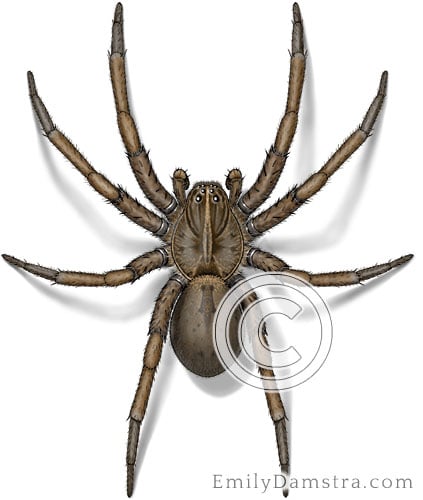
Scientific illustration for identification purposes
Overview
Wolf spiders are large, hairy hunting spiders that chase down prey rather than building webs. They look intimidating but are not dangerous to humans. Females carry egg sacs and spiderlings on their bodies.
How to Identify
- Large size - up to 2 inches including legs
- Hairy brown or gray body
- Distinctive eye arrangement (4 small, 2 medium, 2 large)
- Fast running speed
- Do not build webs
Behavior
Wolf spiders are active hunters that chase down prey. They are nocturnal and hide during the day. Females carry egg sacs attached to their spinnerets and carry hatched spiderlings on their backs.
Habitat
Found in leaf litter, under stones, in burrows, and in vegetation. Enter homes accidentally while hunting. Often found along walls and in basements.
Diet
Hunt and capture insects and other small arthropods. Do not use webs to catch prey.
Reproduction
Females produce egg sacs that they carry attached to spinnerets. After hatching, spiderlings ride on the mothers back until their first molt.
Distribution in the Southern U.S.
Very common throughout Texas, Oklahoma, Louisiana, and Mississippi.
Regional Notes
Wolf spiders are among the most common large spiders encountered in Southern homes. Their size often causes concern, but they are harmless.
Signs of Infestation
- Large hairy spiders running along walls or floors
- Spider seen carrying egg sac or babies
- Spiders hunting at night
- No webs present (they are hunters)
- Spider retreating into burrows or crevices
Prevention Tips
- Seal gaps around doors and windows
- Remove debris and leaf litter from foundation
- Turn off outdoor lights that attract prey insects
- Vacuum regularly to remove insects
- Seal cracks in foundation
- Reduce clutter in basements and garages
When to Contact a Professional
Professional treatment is usually not needed for wolf spiders. Contact a professional if you want comprehensive pest control to reduce all spider and insect populations.
Romex Pest Control provides professional wolf spider control services across Texas, Oklahoma, Louisiana, and Mississippi.
Learn about our wolf spider control servicesFrequently Asked Questions
Are wolf spiders dangerous?
Wolf spiders are not dangerous. While they can bite if handled roughly, their venom is not medically significant to humans. Bites may cause mild, localized pain and swelling.
Why is the spider carrying something on its back?
Female wolf spiders carry their egg sac attached to their spinnerets. After eggs hatch, spiderlings ride on the mothers back until their first molt. This is normal maternal care for these spiders.
Latest Research & News
Recent developments about wolf spider
Get the latest news and research about wolf spider
Click "Load News" to fetch recent articles from scientific sources