
All Articles/
Pest Education
Ants

How to Get Rid of Fire Ants in Texas: The Complete Homeowner's Guide

EH
Ella Hansen
May 12, 2026Updated May 14, 202614 min read0 views
Expert Reviewed5 Sources CitedLicensed Pest Control ProfessionalsServing TX, OK, LA & MS Since 2016
How to Get Rid of Fire Ants in Texas: The Complete Homeowner's Guide

Quick Answer

A licensed pest pro's field-tested guide to eliminating fire ant colonies in Texas yards. Learn which DIY methods actually work, which are a waste of money, and when to call a professional—with step-by-step instructions for every approach.

If you live in Texas, you already know: fire ants are everywhere. The red imported fire ant (Solenopsis invicta) arrived in the United States through the Port of Mobile, Alabama, in the 1930s and spread across every county in Texas by the 1990s. Today there are an estimated 20 to 40 mounds per acre on untreated residential land in DFW, Austin, San Antonio, and East Texas.

Fire ants are more than a nuisance. Their stings send roughly 14 million Americans to the medicine cabinet every year and cause fatal anaphylaxis in a small number of hypersensitive individuals. They damage electrical equipment, undermine driveways and foundations, and kill ground-nesting wildlife. The Texas A&M AgriLife Extension estimates fire ants cost Texans more than $1.2 billion annually in medical treatment, property damage, and agricultural loss.

This guide was written by licensed pest control technicians who treat fire ant infestations across Texas every week. We will walk you through every proven elimination method—what actually works, what is a waste of your Saturday, and when it makes sense to call a professional.

What Are Red Imported Fire Ants?

Red imported fire ants (RIFAs) are small, aggressive, reddish-brown ants between 1/16 and 1/4 inch long. A single colony can contain 200,000 to 500,000 workers and one or more egg-laying queens. Colonies with multiple queens—called polygyne colonies—are increasingly common in Texas and are significantly harder to eliminate because the workers freely move between interconnected mounds.

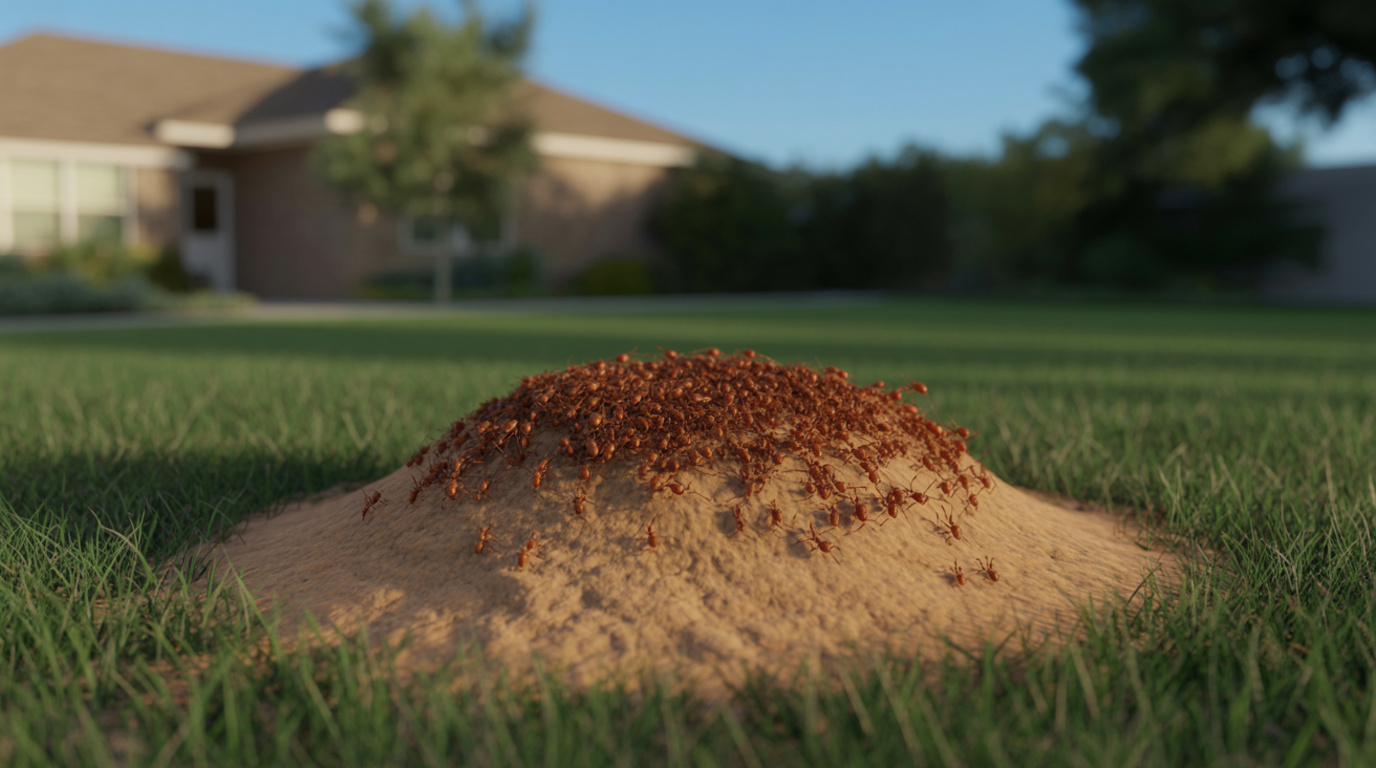
Fire ants build distinctive dome-shaped mounds of loose, finely textured soil. Mounds typically range from 6 to 18 inches tall, though in clay-heavy Texas soil they can reach two feet. Unlike many ant species, fire ants do not create a visible entry hole at the top of the mound. Instead, they tunnel laterally and emerge through cracks in the surrounding soil, which is why stepping on or near a mound triggers an immediate swarm.

How to Identify a Fire Ant Mound

  • Shape: Dome or irregularly shaped mound of loose, granular soil—no visible entrance hole on top.
  • Size: 6 inches to 2 feet tall; can be wider underground than what you see on the surface.
  • Location: Sunny areas—lawns, garden beds, along sidewalks and driveways, near A/C units, around foundations, and in electrical boxes.
  • Activity test: Gently push a stick into the mound. Fire ants will boil out aggressively within seconds and immediately try to climb the stick and sting.
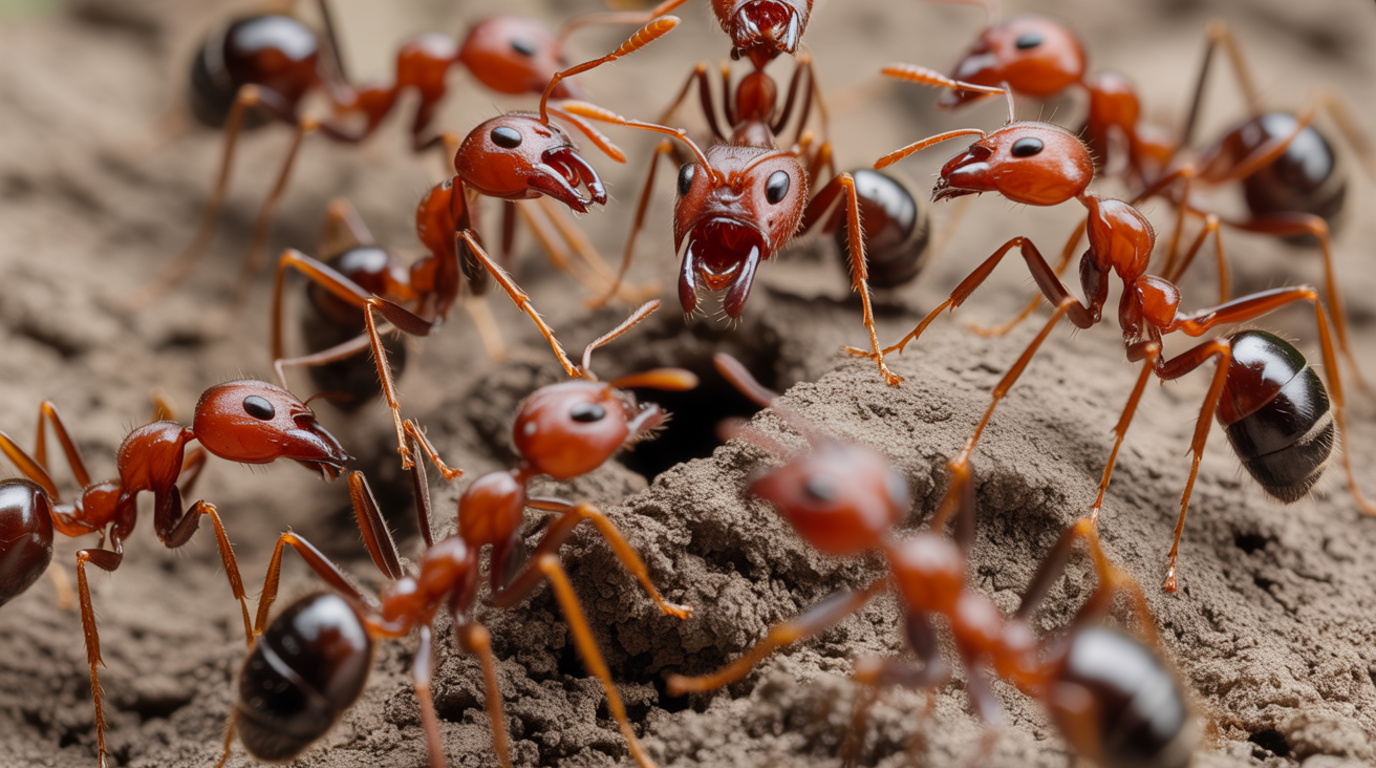
Close-up macro photo of red imported fire ants swarming aggressively on a mound in defensive posture with mandibles open
Red imported fire ants react aggressively when their mound is disturbed—which is why stepping near one triggers an immediate swarm of stings.

Fire Ant Bites and Stings: What to Know

Technically, fire ants sting, not bite. They grip your skin with their mandibles (the bite) to anchor themselves, then curl their abdomen and inject venom from a stinger at the tip. Each ant can sting multiple times.

What a Fire Ant Sting Looks Like

  1. Immediate: Intense burning sensation and a small red welt.
  2. 4–8 hours: The welt develops into a raised, itchy bump.
  3. 24 hours: A distinctive white pustule forms at the sting site. This is the hallmark of a fire ant sting and distinguishes it from mosquito bites, flea bites, or other insect stings.
  4. 3–7 days: The pustule dries up and the area heals. Avoid popping it—breaking the skin invites secondary infection.

When to Seek Medical Attention

Most fire ant stings resolve on their own. However, seek emergency medical care immediately if you experience:

  • Difficulty breathing, swelling of the tongue or throat
  • Dizziness, rapid pulse, or a feeling of faintness
  • Widespread hives or swelling away from the sting sites
  • Nausea, vomiting, or abdominal cramps

These are signs of anaphylaxis—a life-threatening allergic reaction. The CDC estimates about 1% of the population is at risk. If you have had a severe reaction to fire ant stings in the past, carry an epinephrine auto-injector (EpiPen) and inform your household.

First Aid for Fire Ant Stings

  1. Brush ants off your skin quickly—they grip tight, so a fast, firm brush works better than trying to pick them off individually.
  2. Wash the area with soap and water.
  3. Apply a cold compress (ice pack wrapped in a towel) for 15 minutes to reduce swelling.
  4. Apply over-the-counter hydrocortisone cream or take an oral antihistamine (like Benadryl) for itching.
  5. Do not pop the white pustules. They are sterile and popping them increases infection risk.

The Two-Step Method: Gold Standard for Fire Ant Control

Texas A&M AgriLife Extension and every land-grant university extension service in the Southeast recommends the Two-Step Method as the most effective, cost-efficient approach to fire ant control. It combines a broadcast bait application (Step 1) with individual mound treatments (Step 2) for any colonies that survive.

Step 1: Broadcast Bait Application

Broadcast bait is the foundation of any serious fire ant program. You spread it across your entire yard—not on individual mounds—and let the foraging worker ants carry it back to the colony and feed it to the queen.

How it works: Fire ant bait consists of an insecticide or insect growth regulator dissolved in soybean oil and applied to a corn grit carrier. Worker ants find the grit, carry it underground, and share it through the colony's food-sharing process (trophallaxis). The queen ingests the poison and either dies or becomes sterile, collapsing the colony over days to weeks.

Best products (available at home improvement stores):

  • Hydramethylnon baits (e.g., Amdro): Kill the queen within 1–2 weeks. Fast-acting.
  • Spinosad baits (e.g., Greenlight, Ferti-Lome): Derived from a naturally occurring soil bacterium. Kills within 2–4 weeks.
  • Methoprene / Pyriproxyfen baits (insect growth regulators): Don't kill ants directly—they prevent the queen from producing viable eggs. Slower (6–8 weeks) but very effective long-term.
  • Abamectin baits (e.g., Ascend, Clinch): Effective within 2–6 weeks.

Application rules that matter:

  • Timing: Apply when ants are actively foraging—ground temperature between 65°F and 90°F. In Texas, that typically means early morning or late evening from March through November. Avoid midday summer heat.
  • Fresh bait only: Ants reject stale, rancid soybean oil. If the bait has been open for more than a few months or smells off, replace it.
  • Dry conditions: Apply when the ground is dry and no rain is expected for 24 hours. Wet bait decomposes and ants won't pick it up.
  • Rate: Follow the label. Most baits call for 1 to 1.5 pounds per acre (about 1 tablespoon per 1,000 sq ft). A hand-held spreader works well for residential lawns.
  • Do NOT apply bait directly to mounds. Scatter it across the entire yard. Ants forage up to 100 feet from the mound—they will find it.

Step 2: Individual Mound Treatment (7–10 Days Later)

Wait 7 to 10 days after broadcasting bait, then treat any surviving mounds individually. The delay is critical—it gives the bait time to circulate through the colony and kill or sterilize the queen. Treating mounds too early scatters the workers before they carry enough bait underground.

Effective mound drench options:

  • Liquid insecticide drench: Mix a labeled product (bifenthrin, permethrin, or carbaryl) with water per label instructions. Pour 1–2 gallons slowly over and around the mound. The goal is to saturate the entire underground chamber, not just the surface.
  • Granular contact insecticide: Sprinkle granules around and on top of the mound, then water them in with a gentle spray from a garden hose.
  • Dust treatments: Acephate (Orthene) dust is highly effective. Sprinkle it directly on the mound without disturbing it—the ants will walk through it and spread it through the colony. Be aware: acephate has a strong odor.

Why the Two-Step Method Works

The broadcast bait eliminates 80–90% of fire ant colonies across your entire property—including hidden colonies you never knew existed. The follow-up mound treatment handles the survivors. Together, they provide 80–95% control for 6 to 12 months, which is as close to "total elimination" as fire ant management gets.

A single mound treatment alone only kills the mound you can see. The colony may survive by relocating the queen deeper underground, and neighboring colonies expand to fill the gap. That is why the broadcast-first approach is so much more effective than spot-treating individual mounds.

DIY Fire Ant Treatments: What Works and What Doesn't

Homeowners try a lot of creative approaches. Here is an honest breakdown of what works, what sort of works, and what is a complete waste of time.

Methods That Work

Boiling Water

Verdict: Works, but with major caveats.

Pouring 3 to 4 gallons of boiling water directly onto a fire ant mound kills roughly 60% of the colony on contact. The heat must penetrate deep enough to reach the queen and brood chambers, which can be 2 to 3 feet underground in established mounds.

Pros: Free, chemical-free, immediately satisfying.

Cons: Burns the grass and any plants around the mound. Dangerous to handle 3+ gallons of boiling water outside. Often fails to reach the queen, meaning the colony relocates and rebuilds nearby within days. Not practical for yards with 10+ mounds.

Broadcast Bait (See Two-Step Method Above)

Verdict: The single most effective DIY method. This is what the professionals use, just scaled for residential yards. A $15 bag of fire ant bait treats up to half an acre.

Mound Drench with Labeled Insecticide

Verdict: Effective for individual mounds when done correctly. The key is using enough volume (1–2 gallons) to flood the entire underground chamber, not just wet the surface.

Methods That Do NOT Work

Gasoline

Verdict: Dangerous and illegal. Pouring gasoline on a fire ant mound is a fire hazard, contaminates soil and groundwater, kills surrounding plants, and is illegal in most Texas municipalities. It also does not reach the queen. Do not do this.

Grits, Baking Soda, Club Soda, or Vinegar

Verdict: Myths. The "grits myth" claims ants eat dry grits, which expand in their stomachs and kill them. Fire ants are liquid feeders—adult workers cannot eat solid food. They feed solids to larvae, which convert them to liquid and regurgitate it back to the workers. Grits do not kill fire ants. Period. The same applies to baking soda, club soda, instant rice, and other kitchen remedies. None have any scientific support.

Shoveling One Mound onto Another

Verdict: Myth. This old wives' tale claims the two colonies will fight and destroy each other. In reality, the relocated ants will simply scatter, and if the colonies have the same number of queens (or are polygyne), they may actually merge into a larger super-colony. You end up with more fire ants, not fewer.

Diatomaceous Earth Alone

Verdict: Minimally effective. DE can kill individual ants that walk through it, but it cannot penetrate deep enough into the colony to reach the queen. It also becomes useless when wet—a problem in Texas where morning dew, irrigation, and rain are constant factors.

When to Call a Professional

DIY fire ant control works well for light to moderate infestations on smaller properties. However, consider calling a licensed ant control professional when:

  • Your yard has more than 10–15 visible mounds. Heavy infestations often indicate polygyne (multi-queen) colonies that are harder to eliminate with bait alone.
  • Mounds keep coming back within a few weeks of treatment. The colony may be relocating rather than dying.
  • Fire ants are invading your home, garage, or electrical equipment. Interior infestations and HVAC/electrical box colonies require targeted treatment that goes beyond broadcast bait.
  • Someone in your household has a fire ant allergy. Professional treatment provides faster, more thorough elimination.
  • You have a large property (half acre or more). Professional-grade equipment distributes bait more evenly than hand spreaders.

What Professional Fire Ant Treatment Looks Like

At Romex, our fire ant treatment follows the same science-backed two-step protocol that university extension services recommend—but with professional-grade products, calibrated equipment, and recurring service to maintain results.

  1. Inspection: We walk your entire property to assess mound density, colony type (monogyne vs. polygyne), and any fire ant activity inside the structure or near electrical equipment.
  2. Broadcast application: Professional-grade bait is applied across the full property using a calibrated spreader.
  3. Individual mound treatment: Active mounds near the home, play areas, walkways, and pet areas receive a direct contact treatment.
  4. Perimeter barrier: A residual product is applied around your home's foundation to prevent new colonies from establishing near the structure.
  5. Recurring service: Fire ants reinvade from neighboring properties. Romex recommends service every other month to quarterly to keep the barrier effective and catch new mounds before they establish.

How Much Does Professional Fire Ant Treatment Cost?

Professional fire ant treatment in Texas typically costs between $150 and $350 for an initial treatment on a standard residential lot (under half an acre). Ongoing quarterly treatments range from $100 to $200 per visit. Most pest control companies, including Romex, offer bundled plans that include fire ant control as part of your general pest program—which is almost always more cost-effective than standalone fire ant service. See our pest control cost guide for detailed pricing.

How to Prevent Fire Ants from Coming Back

Fire ants cannot be permanently eradicated from a Texas property. New queens fly in during mating flights (typically April–June), and foragers from neighboring untreated land will recolonize open territory. The goal is sustained suppression, not one-time elimination. Here is how to maintain a fire-ant-free yard:

  • Apply broadcast bait twice a year. Once in spring (March–April) and once in fall (September–October) when ants are most actively foraging. This is the single most impactful thing you can do.
  • Inspect your yard monthly. Walk the property and spot-treat new mounds before they mature. A new mound is much easier to kill than an established one with 200,000 workers.
  • Keep your lawn healthy. Dense, well-maintained turf makes it harder for fire ant queens to establish new colonies. Water deeply but infrequently to avoid the soggy soil conditions fire ants prefer.
  • Reduce harborage. Fire ants love to nest under landscape timbers, pavers, firewood piles, compost bins, and A/C pads. Inspect these areas regularly.
  • Protect electrical equipment. Fire ants are attracted to electrical fields and frequently infest breaker boxes, A/C contactors, and irrigation timers. Treat around these with a labeled dust or granular product.

Fire Ant Control by Texas Region

Fire ant pressure varies across Texas depending on climate, soil type, and rainfall. Here is what we see across our service areas:

DFW Metroplex (Dallas, Fort Worth, Plano, Frisco, McKinney)

DFW's heavy clay soil produces tall, hard-packed mounds that are difficult to drench effectively. Peak activity runs from April through October. The western portions of the metroplex (Fort Worth, Weatherford) tend to have slightly lower mound density than the eastern side. Our Dallas, Fort Worth, Plano, Frisco, and McKinney locations see fire ants as one of the top two service requests year-round.

Austin & Central Texas

Rocky limestone soil in the Hill Country forces fire ants to build broader, shallower mounds closer to the surface. These colonies are actually easier to treat with mound drenches because the tunnels don't go as deep. Once you're east of I-35 toward Bastrop and Elgin, the sandy loam soil produces classic deep mounds. See our Austin, Round Rock, and Georgetown location pages for local details.

San Antonio & South Texas

San Antonio's longer warm season means fire ants are active nearly year-round, with only a brief slowdown in January and February. The mix of clay and caliche soil creates stubborn mounds that resist water penetration. San Antonio, New Braunfels, and Boerne homeowners should expect to treat more frequently than DFW properties.

Tyler & East Texas

East Texas has the highest fire ant density in the state. Sandy soil, warm temperatures, and ample rainfall create ideal conditions. Mound counts of 40 or more per acre are not unusual on untreated land. Our Tyler, Longview, and Jacksonville teams treat fire ants on nearly every service call.

Frequently Asked Questions

How long does it take to get rid of fire ants?

Using the two-step method, you should see an 80–90% reduction in mound activity within 2 to 4 weeks. Complete suppression of visible mounds typically takes 4 to 6 weeks. However, reinfestation from neighboring properties means ongoing maintenance is necessary.

What is the fastest way to kill a fire ant mound?

A liquid insecticide drench kills a mound within 24 to 48 hours. Acephate (Orthene) dust works within hours. Boiling water produces instant kills but rarely eliminates the entire colony. Baits are slower (1–6 weeks) but far more effective at killing the queen and collapsing the colony permanently.

Does boiling water really kill fire ants?

Yes—boiling water kills about 60% of the colony it contacts. The problem is that fire ant nests extend 2 to 3 feet underground in established mounds, and boiling water rarely penetrates that deep. The queen often survives and relocates the colony. It works best on brand-new, small mounds.

Are fire ants dangerous to pets?

Yes. Dogs and cats that step on or lie near a fire ant mound can receive dozens or hundreds of stings in seconds. Small pets, puppies, kittens, and animals tethered near mounds are at highest risk. Symptoms include swelling, pain, and in rare cases anaphylaxis. If your pet is stung, brush off the ants, apply a cold compress, and contact your veterinarian if symptoms are severe.

Why do fire ants come back after I treat them?

Fire ant queens produce up to 1,500 eggs per day. New queens disperse during mating flights and can land anywhere in your yard. Colonies from neighboring untreated properties also forage into your space. This is why one-time treatment rarely provides lasting results—ongoing suppression through regular broadcast bait applications and professional service is the proven long-term strategy.

Can I get rid of fire ants naturally?

Spinosad-based baits are derived from a naturally occurring soil bacterium and are approved for organic production. They are the most effective "natural" option. Boiling water is chemical-free but has limited effectiveness. Diatomaceous earth, nematodes, and essential oils have minimal impact on established colonies. Romex also offers all-natural treatment options upon request—ask your technician for details.

Take Back Your Yard

Fire ants are a fact of life in Texas, but a yard full of painful mounds does not have to be. The two-step method—broadcast bait followed by targeted mound treatment—is scientifically proven, cost-effective, and achievable as a DIY project or with professional help.

If you are dealing with a heavy infestation, recurring mounds, or fire ants inside your home or near electrical equipment, contact Romex Pest Control for a quote. Our technicians serve every major metro in Texas and treat fire ants on a daily basis. We will get your yard back to a place where you can actually enjoy it.

Learn more about our ant control services →

References & Sources

  • [1]
    Texas A&M AgriLife Extension — Managing Red Imported Fire AntsVisit Source(Accessed: 2026-05-14)
  • [2]
    University of Texas at Austin — Fire Ant FAQVisit Source(Accessed: 2026-05-14)
  • [3]
    EPA — Fire Ant Control ProductsVisit Source(Accessed: 2026-05-14)
  • [4]
    CDC — Fire Ants: Symptoms and First AidVisit Source(Accessed: 2026-05-14)
  • [5]
    Mississippi State University Extension — The Two-Step MethodVisit Source(Accessed: 2026-05-14)

Editorial Standards

All content is reviewed by licensed pest control professionals and fact-checked against university extension publications and peer-reviewed research. We prioritize accuracy and practical, actionable advice based on real-world experience serving 28,000+ families since 2016.

Related Topics

Need Professional Pest Control?

Locally managed since 2016. All-natural options available upon request. Get a customized treatment plan.

EH

Written by

Ella Hansen

Pest Control Marketing Expert at Romex Pest Control

Ella Hansen leads pest control content strategy at Romex Pest Control, working directly with licensed field technicians across Texas, Oklahoma, Louisiana, and Mississippi to translate real-world treatment experience into practical homeowner guidance.

Licensed Pest Control Professionals
Serving TX, OK, LA & MS Since 2016
Call Now