
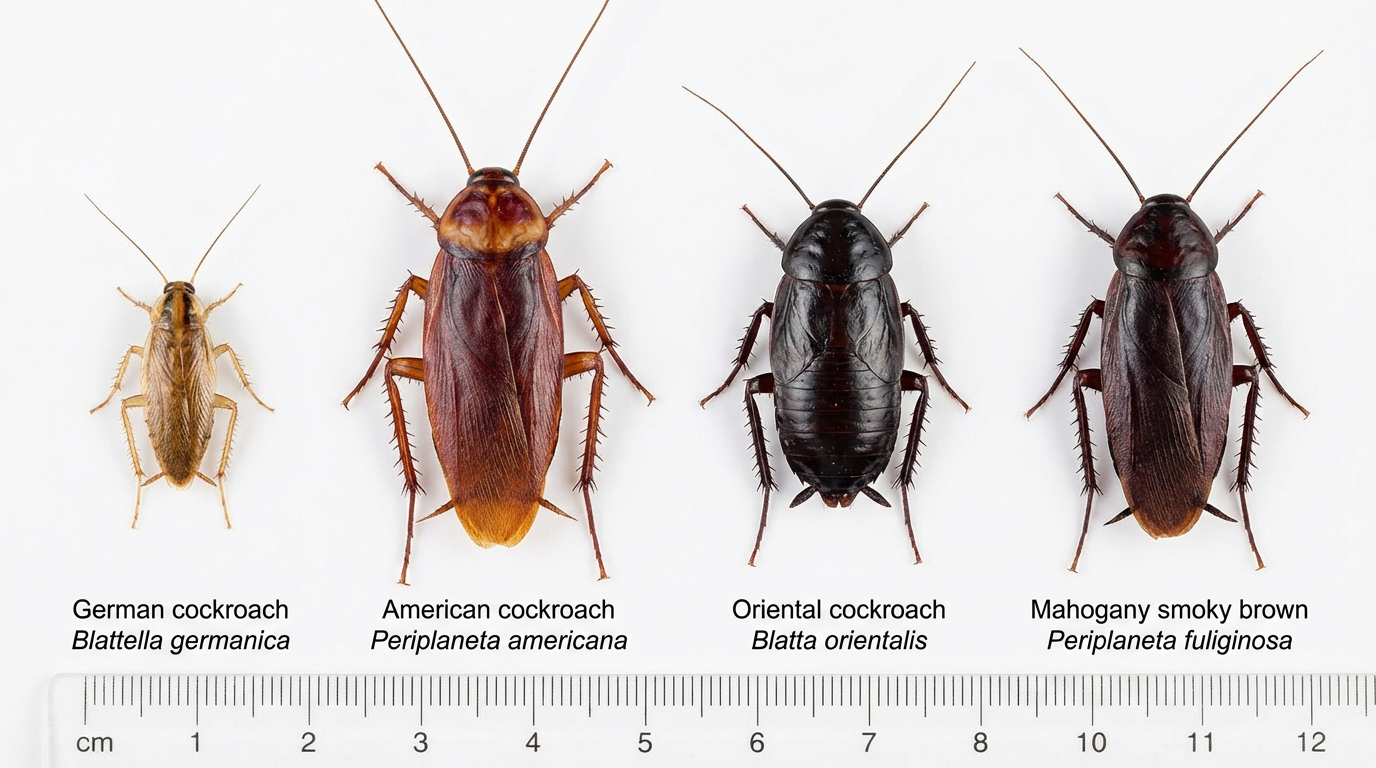
Why Correct Identification Matters
Seeing a cockroach in your kitchen can trigger immediate alarm, but not every roach requires the same response. The treatment strategy for a German cockroach infestation is fundamentally different from what works for an American cockroach or an occasional smoky brown roach that wandered in from outside. If you have confirmed German cockroaches, our guide on how to get rid of German cockroaches covers what actually eliminates them and how long treatment takes.
According to the CDC, proper identification is crucial for effective pest management.
German cockroaches are exclusively indoor pests—they live, breed, and complete their entire lifecycle inside your home. American and smoky brown cockroaches, by contrast, typically live outdoors and only enter structures occasionally. Misidentifying the species can lead to wasted time and money on ineffective treatments.
Here is how to confidently identify the four most common cockroach species found in Texas, Oklahoma, Louisiana, and Mississippi homes.
Ready to Get Started?
Free quote • No obligation • Same-day service available
German Cockroach (Blattella germanica)
Appearance
German cockroaches are the smallest of the common household species at 13 to 16 millimeters long (roughly half an inch). They are tan to light brown with two distinctive parallel dark stripes running lengthwise on the pronotum—the shield-like plate directly behind the head. This double-stripe pattern is the single most reliable visual identifier.
Both males and females have fully developed wings that cover the abdomen, but they almost never fly. Nymphs are smaller, darker (nearly black when young), and wingless, with a single light stripe running down the center of their back.
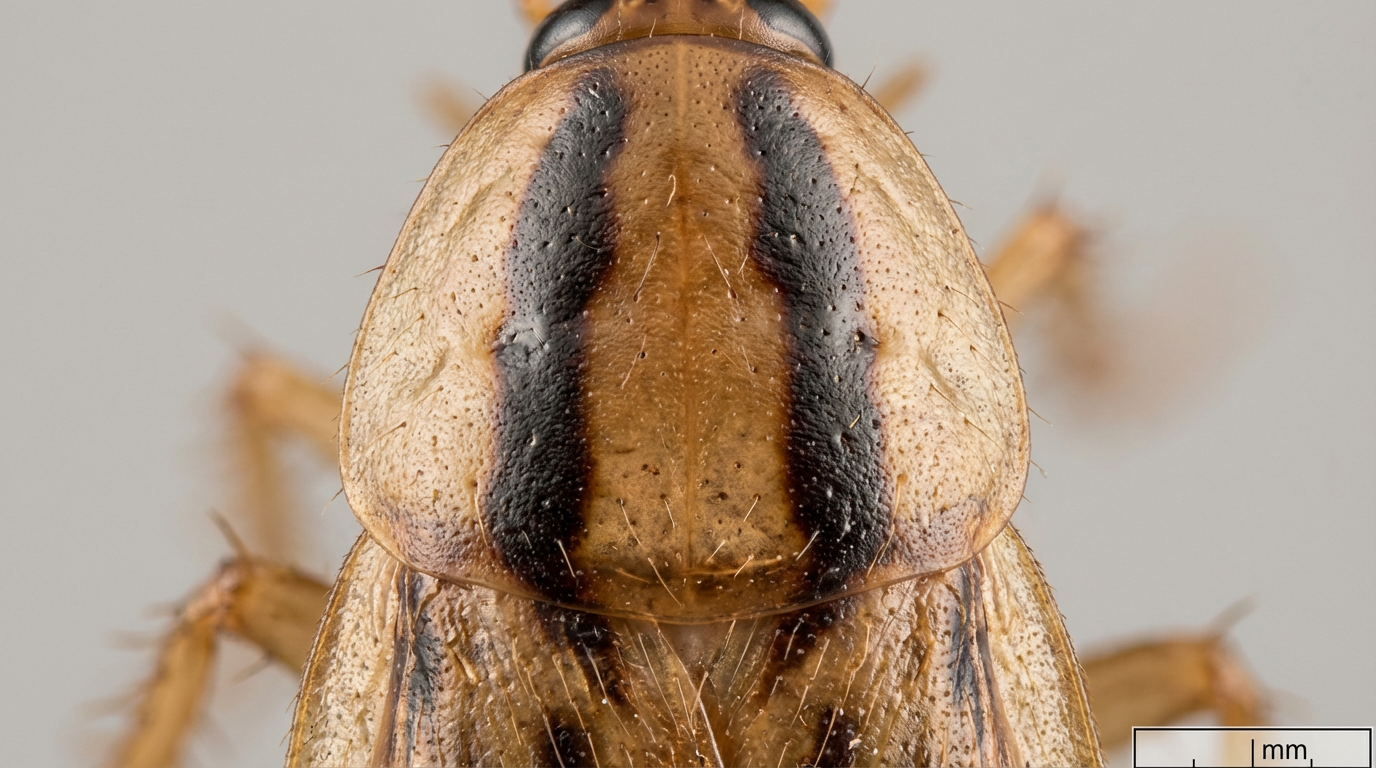
The two parallel dark stripes on the pronotum are the most reliable way to identify a German cockroach.
Behavior and Habitat
German cockroaches are strictly indoor pests. You will find them in kitchens, bathrooms, and anywhere with consistent warmth, moisture, and food. They are nocturnal and thigmotactic, preferring to squeeze into cracks and crevices during the day. If you see German cockroaches during daylight hours, it typically indicates a severe infestation—the harborage areas are overcrowded.
Droppings
German cockroach droppings appear as small dark specks or smears, resembling ground black pepper or coffee grounds. You will find them concentrated around harborage areas, along cabinet edges, inside drawers, and behind appliances. In heavy infestations, droppings accumulate into visible dark staining. Once you have confirmed the species, here is what actually eliminates a German cockroach infestation.
🪳 German Cockroaches Require Professional Treatment
German cockroaches reproduce faster than any other species—one egg case holds 30–40 nymphs. Romex uses targeted bait and growth-regulator protocols that break the breeding cycle.
Get a Quote Now→ 📞 844-955-2447
American Cockroach (Periplaneta americana)
Appearance
The American cockroach is the largest common household species at 32 to 54 millimeters (1.25 to 2 inches). They are reddish-brown with a distinctive yellowish figure-8 pattern on the pronotum. Both sexes have long wings that extend beyond the abdomen, and unlike German cockroaches, American cockroaches can and do fly—particularly in warm weather.
Behavior and Habitat
American cockroaches primarily live outdoors in moist environments: storm drains, sewer systems, mulch beds, tree holes, and around foundations. They enter homes through gaps around pipes, under doors, and through sewer connections. Finding one or two American cockroaches inside does not necessarily indicate an indoor breeding population—they are often wanderers from outdoor colonies.
In Texas, they are commonly called "water bugs" or "palmetto bugs," though these are informal names for the same species.
Droppings
American cockroach droppings are significantly larger—cylindrical pellets with ridged sides and blunt ends, similar in appearance to mouse droppings. This size difference makes it easy to distinguish them from the pepper-like specks of German cockroaches.
Oriental Cockroach (Blatta orientalis)
Appearance
Oriental cockroaches are 25 to 32 millimeters long and have a distinctive glossy, dark brown to jet black appearance—they look almost lacquered. Males have short, non-functional wings covering about 75% of the abdomen. Females are nearly wingless, with only small wing stubs. Neither sex can fly.
Behavior and Habitat
Oriental cockroaches prefer cool, damp, dark environments. They are commonly found in basements, crawl spaces, floor drains, and around leaking pipes. They tolerate cooler temperatures better than other cockroach species but still need moisture. They are slower-moving than German or American cockroaches and produce a distinctive musty odor.
Droppings
Oriental cockroach droppings are similar in size to American cockroach droppings—small dark pellets—but are typically found in damp areas near floor level rather than in upper cabinets and countertops.
Smoky Brown Cockroach (Periplaneta fuliginosa)
Appearance
Smoky brown cockroaches are 33 to 38 millimeters long, uniformly dark mahogany to black-brown with no lighter markings on the pronotum—this uniform dark color distinguishes them from the lighter-headed American cockroach. They have long wings that extend beyond the abdomen and are strong, capable fliers, especially on warm humid nights.
Behavior and Habitat
Smoky brown cockroaches are primarily outdoor pests in the Southern states, living in tree holes, woodpiles, leaf litter, and gutters. They are strongly attracted to light and frequently fly toward porch lights, open windows, and illuminated doorways. Their presence inside is usually incidental rather than indicative of an indoor colony.
Droppings
Similar to American cockroach droppings in size and shape—small ridged cylinders. Location is the best differentiator: smoky brown droppings concentrate in attics, gutters, and near exterior entry points rather than in kitchens and bathrooms.
Quick-Reference Comparison Chart
Feature | German | American | Oriental | Smoky Brown |
|---|---|---|---|---|
Size | 13–16 mm | 32–54 mm | 25–32 mm | 33–38 mm |
Color | Tan/light brown | Reddish-brown | Glossy dark/black | Dark mahogany |
Key Marking | Two dark pronotum stripes | Yellow figure-8 on pronotum | No distinct markings | Uniform dark color |
Flies? | Rarely | Yes, in warm weather | No | Yes, strong flier |
Primary Habitat | Indoors only | Outdoors/sewers | Damp basements | Outdoors/trees |
Droppings | Pepper-like specks | Ridged cylinders | Dark pellets | Ridged cylinders |
Threat Level | High—breeds indoors | Moderate—outdoor colonies | Low—prefers cool, damp areas | Low—primarily outdoor |
Frequently Asked Questions
What attracts cockroaches to my home?
Cockroaches are attracted to food, moisture, and warmth. Keeping your home clean and dry can help deter them.
How can I prevent cockroach infestations?
Seal entry points, reduce clutter, and maintain a clean environment to prevent cockroach infestations. Regular professional inspections can also help.
Are cockroaches harmful?
Yes, cockroaches can carry bacteria and allergens that may pose health risks. It's important to address infestations promptly.
Did You Know?
According to the EPA, cockroaches can trigger asthma and allergies, especially in children. Regular pest control can help mitigate these risks.
Professional Tip
For effective cockroach management, focus on eliminating food and water sources, sealing entry points, and using professional pest control services for persistent infestations.
Author Bio
Ella Hansen is a pest control marketing specialist at Romex Pest Control who leverages in-house expertise and external industry resources to deliver actionable pest management content. With years of experience in the field, Ella is dedicated to providing homeowners with the knowledge they need to tackle pest issues effectively.