
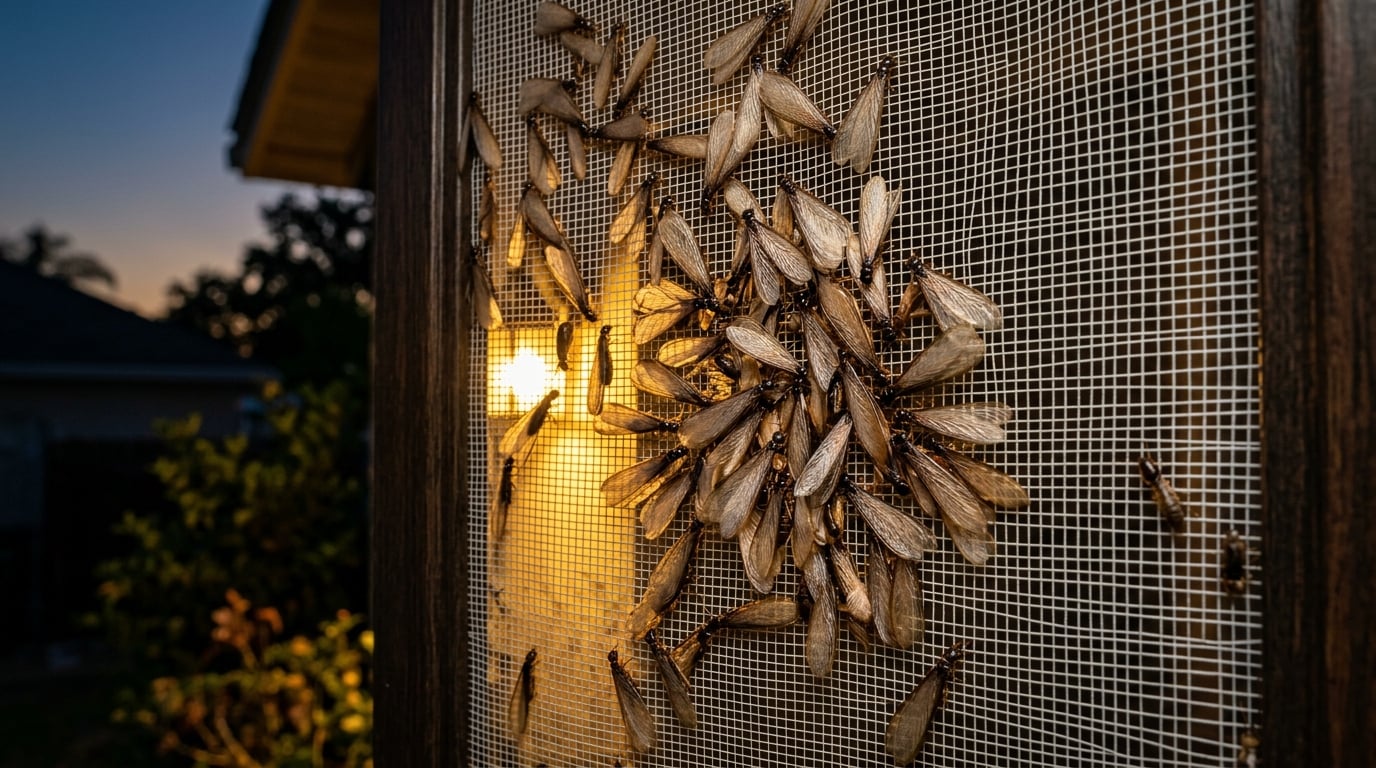
Every spring, millions of homeowners across Texas, Oklahoma, Louisiana, and Mississippi witness a phenomenon that triggers immediate concern: termite swarms. Thousands of winged insects suddenly appear around windows, light fixtures, or exterior walls — and if they're termites, it means a mature colony is living nearby.
Here's everything you need to know about termite swarm season in our service areas.
When Is Termite Swarm Season?
Texas
- Subterranean termites: February through May (peak: March–April)
- Formosan termites: May through June (primarily Houston, Beaumont, and coastal areas)
- Drywood termites: September through November (less common, coastal regions)
Oklahoma
- Subterranean termites: March through June (peak: April–May)
- Formosan termites are less common in Oklahoma but have been found in the southern part of the state
Louisiana & Mississippi
- Subterranean termites: February through April
- Formosan termites: May through June — Louisiana has the highest Formosan termite pressure in the continental U.S.
Trigger conditions: Swarms typically occur after a warm rain when temperatures reach 70°F+. A warm, humid day following rain in March or April is prime swarming weather.
🛡️ Protect Your Home from Termites
Romex Pest Control offers FREE termite inspections across Texas, Oklahoma, Louisiana & Mississippi. Serving since 2016.
Schedule Your FREE Termite Inspection →Ready to Get Started?
Free quote • No obligation • Same-day service available
Are Those Flying Ants or Termite Swarmers?
This is the most common question we get during swarm season. Here's how to tell them apart:
| Feature | Termite Swarmer | Flying Ant |
|---|---|---|
| Wings | Equal length, twice body length | Unequal — front wings longer |
| Body | Straight, thick waist | Pinched, narrow waist |
| Antennae | Straight, beaded | Elbowed, bent |
| Color | Dark brown to black | Dark brown, reddish, or black |
| Shed Wings | Yes — piles near windowsills | Less commonly shed |
Key identifier: If you find piles of shed wings — all the same size — near windows or doors, you're almost certainly looking at termite swarmers.
What Does a Swarm Mean for Your Home?
Swarm Inside Your Home
If winged termites are emerging inside your home — from walls, ceilings, window frames, or floor cracks — this means a mature colony is living in or under your home. Colonies produce swarmers after 3–5 years, which means termites have been active for years.
This requires immediate professional inspection.
Swarm Outside Your Home
Outdoor swarms near your home mean a colony exists nearby — possibly in a tree stump, woodpile, or neighbor's property. While not as immediately concerning, it means termites are in your area and your home could be their next target.
This is a good time to schedule a preventive inspection.
What to Do During a Termite Swarm
- Don't spray them — insect spray kills the visible swarmers but does nothing to the colony. It also makes identification harder for inspectors.
- Collect a sample — capture a few swarmers (alive or dead) in a zip-lock bag for identification.
- Note the location — where exactly are they emerging from? This helps inspectors find the colony.
- Vacuum up the swarm — a vacuum cleaner is the easiest cleanup method. Swarmers are harmless — they don't bite or cause damage.
- Call a professional — schedule an inspection as soon as possible, ideally within 24–48 hours.
Swarm Season Checklist for Homeowners
Before and during swarm season, take these preventive steps:
- ✅ Inspect your foundation for mud tubes — check every side of your home
- ✅ Check moisture around your foundation — fix leaky faucets, clogged gutters, and poor drainage
- ✅ Move firewood and lumber away from your home (at least 20 feet)
- ✅ Remove dead tree stumps from your yard
- ✅ Ensure mulch doesn't contact your foundation wood (maintain a 6-inch gap)
- ✅ Check window and door frames for signs of termite activity
- ✅ Schedule a professional inspection before swarm season starts
Don't wait for a swarm to find out if your home is at risk. Romex Pest Control offers FREE termite inspections across Texas, Oklahoma, Louisiana, and Mississippi — no swarm required.
Ready to Protect Your Home?
Don't wait until termite damage gets worse. Get a FREE professional termite inspection from Romex Pest Control — no obligation, no pressure.
Claim Your FREE Inspection →📞 Or call 844-955-2447
Company Credentials and Certifications
Romex Pest Control is a trusted name in pest management, serving the southern United States since 2016. Our team is certified by the National Pest Management Association (NPMA) and adheres to guidelines set by the Environmental Protection Agency (EPA). We pride ourselves on using tested and approved methods to ensure the safety and effectiveness of our services.
FAQ
- Q: How can I tell if I have termites?
A: Look for mud tubes, discarded wings, and damaged wood. For more detailed signs, visit our Signs of Termite Activity page. - Q: Are termite treatments professional?
A: Our treatments are tested and approved for effectiveness. We follow all EPA guidelines. - Q: How often should I have my home inspected?
A: We recommend annual inspections to catch any potential issues early.
Did You Know?
Termites cause over $5 billion in property damage each year in the U.S. alone, according to the National Pest Management Association. Early detection is key to preventing costly repairs.
Professional Tip
Always keep an eye on your home's humidity levels. Termites thrive in moist environments, so fixing leaks and ensuring proper ventilation can significantly reduce the risk of infestation.
Case Studies
In 2022, Romex Pest Control successfully eradicated a large Formosan termite colony in a historic home in New Orleans. Using a combination of baiting systems and barrier treatments, the team was able to protect the structure without causing any damage to its historic features.
For more information on our services, visit our Service Page.
Company History and Mission
Founded in 2016, Romex Pest Control has been committed to providing effective and professional pest management solutions. Our mission is to protect homes and businesses from pest threats using reliable and tested methods.