
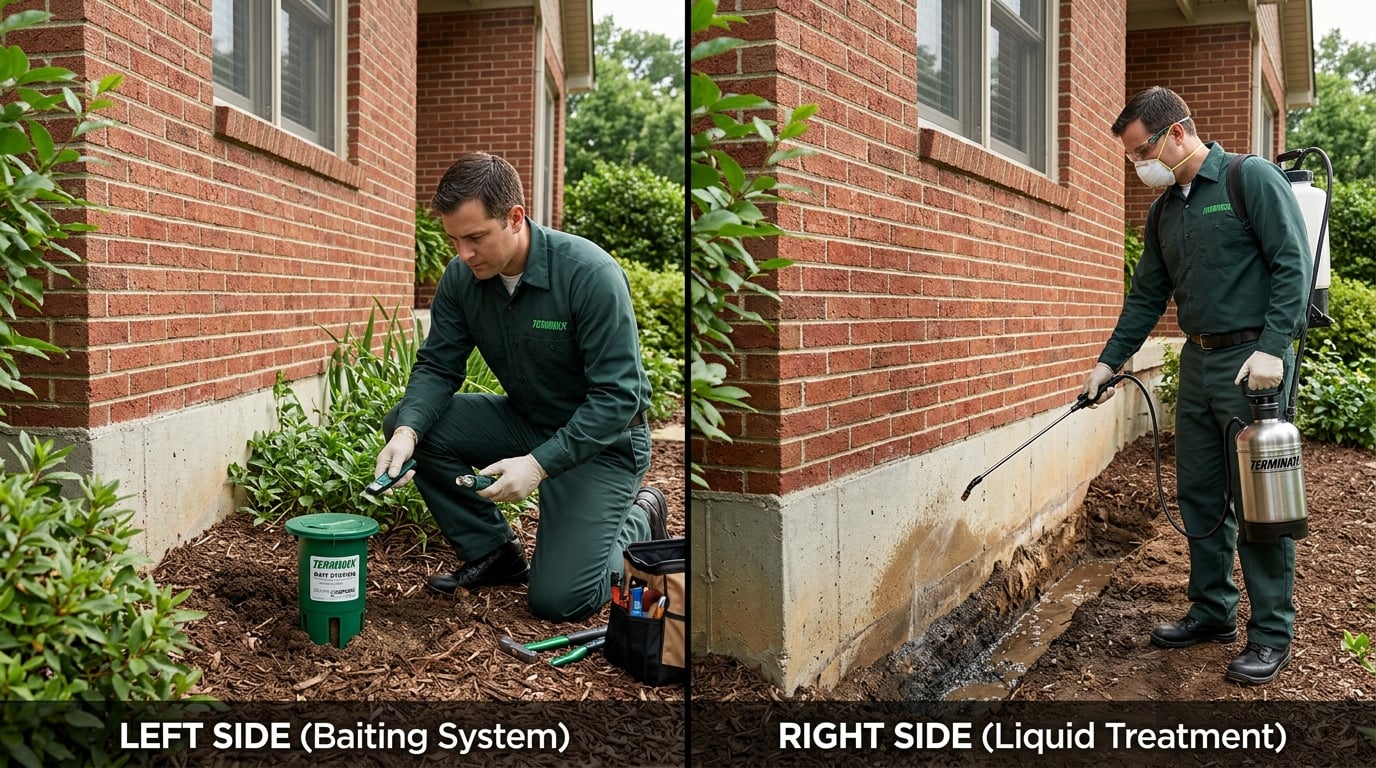
When it comes to termite treatment, two of the most common professional options are Sentricon® bait systems and liquid barrier treatments (like Termidor®). Both are effective, but they work very differently — and the right choice depends on your home, your soil, and your long-term goals.
At Romex Pest Control, we're certified installers of the Sentricon® system and also perform liquid barrier treatments. Here's an unbiased comparison to help you decide.
Understanding Termite Treatments
How Each Treatment Works
Sentricon® Bait System
Sentricon® uses a network of in-ground bait stations installed around your home's perimeter. Termite workers find the bait (which contains noviflumuron), carry it back to the colony, and share it. Over weeks to months, the entire colony — including the queen — is eliminated.
Targets the entire colony, not just foraging termites
Bait stations are checked and maintained quarterly
Minimal disruption to your property (no trenching around foundation)
Professionally targeted — affects only termites, not surrounding soil
Liquid Barrier Treatment (Termidor®, etc.)
Liquid treatments create a chemical barrier in the soil around and under your foundation. Termites that pass through the treated zone are killed or carry the chemical back to nestmates (transfer effect).
Provides immediate protection — active within hours
Creates a continuous barrier around the foundation
Requires trenching or drilling along the foundation perimeter
Typically lasts 5–10 years before retreatment
Did You Know?
According to the EPA, termites cause billions of dollars in structural damage each year in the U.S. alone. Early detection and treatment are crucial to prevent costly repairs.
Ready to Get Started?
Free quote • No obligation • Same-day service available
Head-to-Head Comparison
Factor | Sentricon® | Liquid Barrier |
|---|---|---|
Colony Elimination | ✅ Yes — kills the queen | ⚠️ Partial — kills foragers, colony may survive |
Speed | Weeks to months | Immediate barrier |
Initial Cost | $1,200–$3,500 | $1,000–$3,000 |
Ongoing Cost | $200–$400/year monitoring | None until retreatment (5–10 yrs) |
Property Disruption | Minimal — small stations in ground | Moderate — trenching/drilling required |
Best For | Long-term protection, eco-conscious homeowners | Active infestations needing fast results |
Professional Tip
For homes in high-pressure termite zones like Texas, Louisiana, Oklahoma, and Mississippi, consider a combination approach for optimal protection.
When to Choose Sentricon®
You want to eliminate the entire colony — Sentricon® is the only treatment proven to destroy the queen and the colony itself
You have a well-established landscape — no trenching means your flowerbeds, walkways, and patio stay intact
You want ongoing monitoring — quarterly inspections catch new termite activity before it becomes an infestation
Environmental concerns — the bait only affects termites, with minimal soil impact
When to Choose Liquid Barrier
You have active termites and need fast results — liquid barriers work within hours of application
You prefer a one-time treatment — no annual monitoring fees (though retreatment is eventually needed)
Pre-construction treatment — liquid treatments are excellent for new builds before the slab is poured
Budget-focused — lower upfront cost with no recurring fees
Our Recommendation: Combination Approach
For most homeowners in high-pressure termite zones (like Texas, Oklahoma, Louisiana, and Mississippi), we often recommend a combination approach:
Liquid barrier to stop current termite activity immediately
Sentricon® bait system for long-term colony elimination and ongoing monitoring
This gives you the best of both worlds — immediate protection plus long-term colony destruction. It's the approach we use on our most valuable properties and the one we recommend to homeowners who want the highest level of protection.
Not sure which treatment fits your situation? A FREE termite inspection from Romex will identify the species, assess the severity, and help you choose the right plan.
FAQs
What termite species are common in Texas? — The most common species include subterranean termites, which are highly destructive.
How often should I inspect for termites? — It's recommended to have professional inspections annually, especially in high-risk areas.
What precautions should I take with pets? — Both treatments use EPA-registered products applied according to label directions, and your technician explains product-specific precautions. If your specific concern is kids or pets, here's what each one contains and where it's placed on your property — including the federal labeling rule that explains why no pest control company can call a product "safe.”
Ready to Protect Your Home?
Don't wait until termite damage gets worse. Get a FREE professional termite inspection from Romex Pest Control — no obligation, no pressure.
📞 Or call 844-955-2447
Conclusion
Choosing the right termite treatment for your home involves considering your specific needs, budget, and environmental concerns. Both Sentricon® and liquid barrier treatments offer distinct advantages, and in many cases, a combination approach provides the most comprehensive protection. Consult with a professional to tailor a plan that best suits your home and region.
For more information on our services, visit our services page.
Author Information
Ella Hansen is a pest control marketing specialist at Romex Pest Control who leverages in-house expertise and external industry resources to deliver actionable pest management content. With years of experience in the industry, Ella provides insights that help homeowners make informed decisions about pest control.
For further reading, check out the CDC and EPA websites for more information on pest control and safety guidelines.